Laser Clearance Inspection System
Dynamic 3D laser inspection for vehicle clearance.
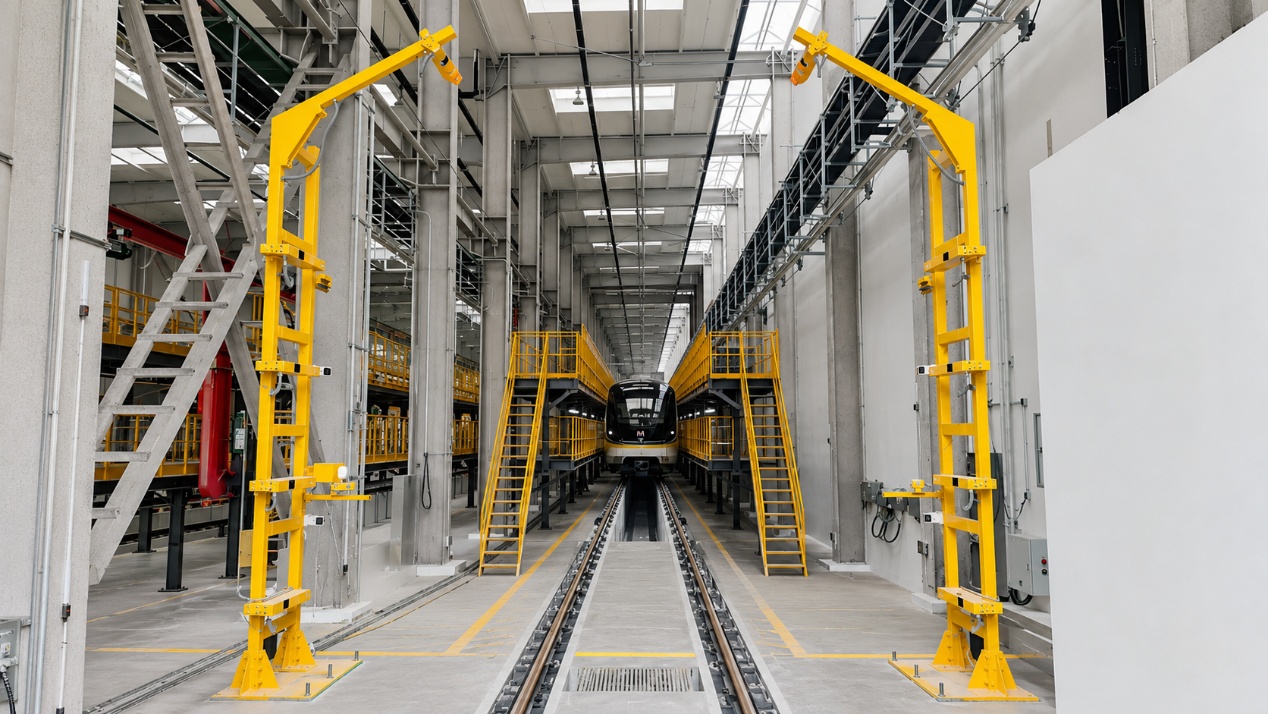
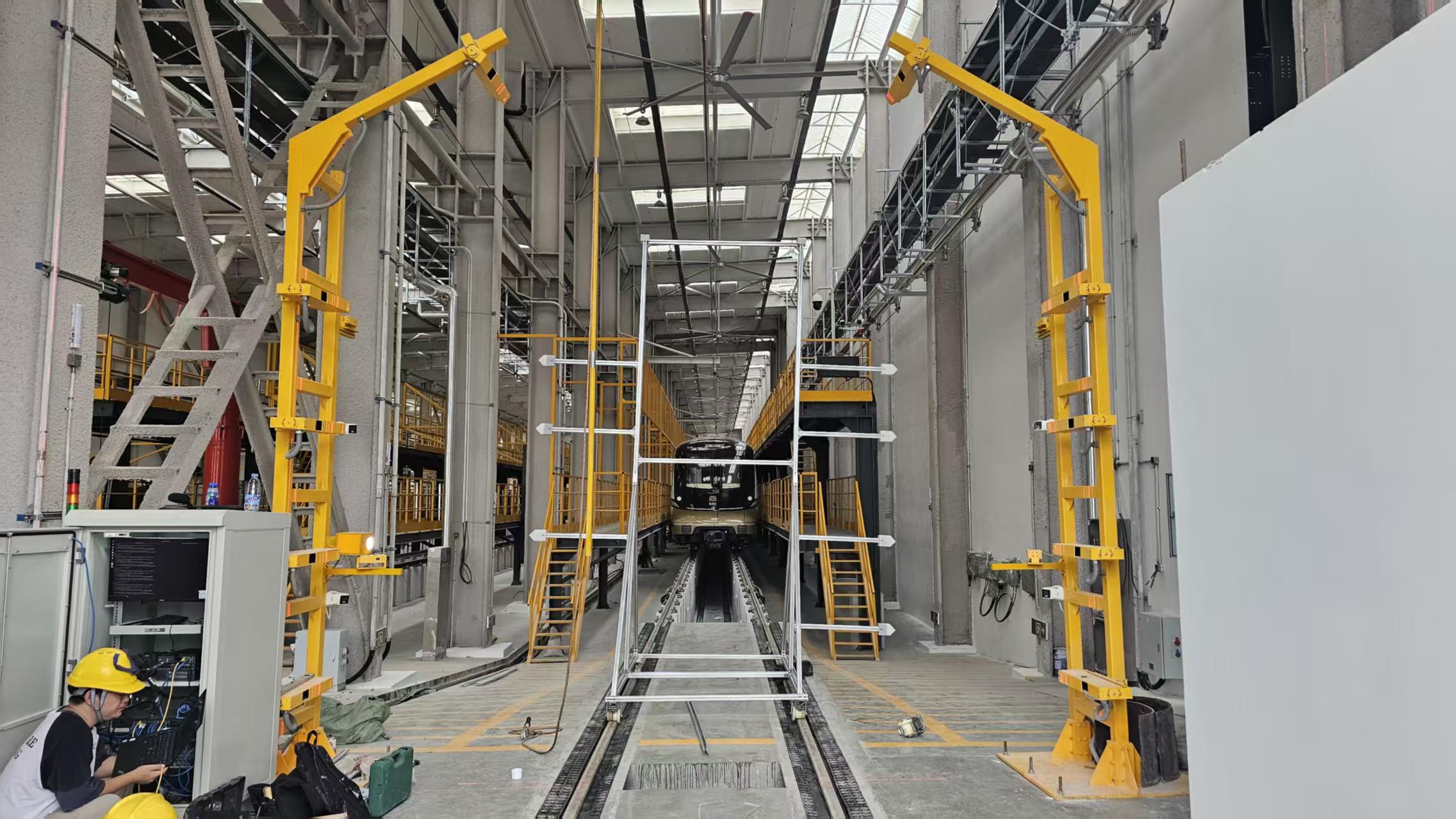
A non-contact dynamic limit detection system, based on a 3D laser profilometer and machine vision, automatically performs external profile acquisition, limit exceedance assessment, and audio-visual alarms when vehicles pass through; this system provides real-time limit safety assurance for the entry and exit operations of rail transit vehicles during maintenance.
Solution
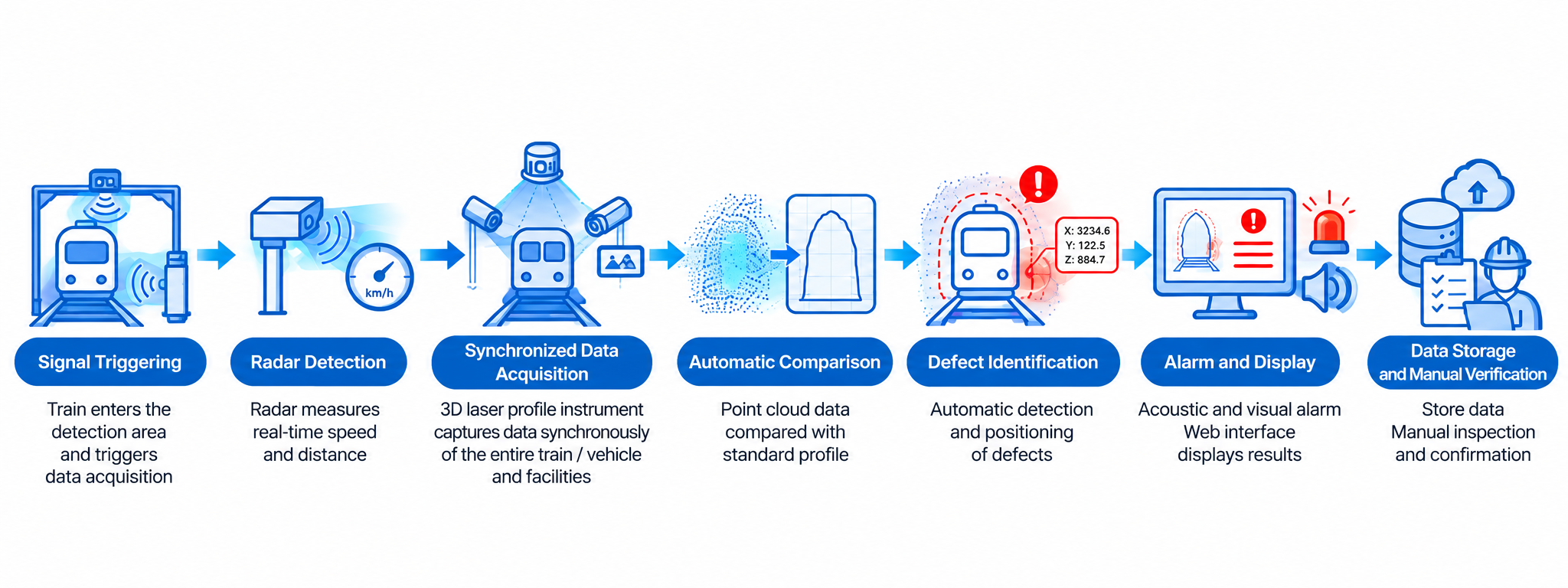
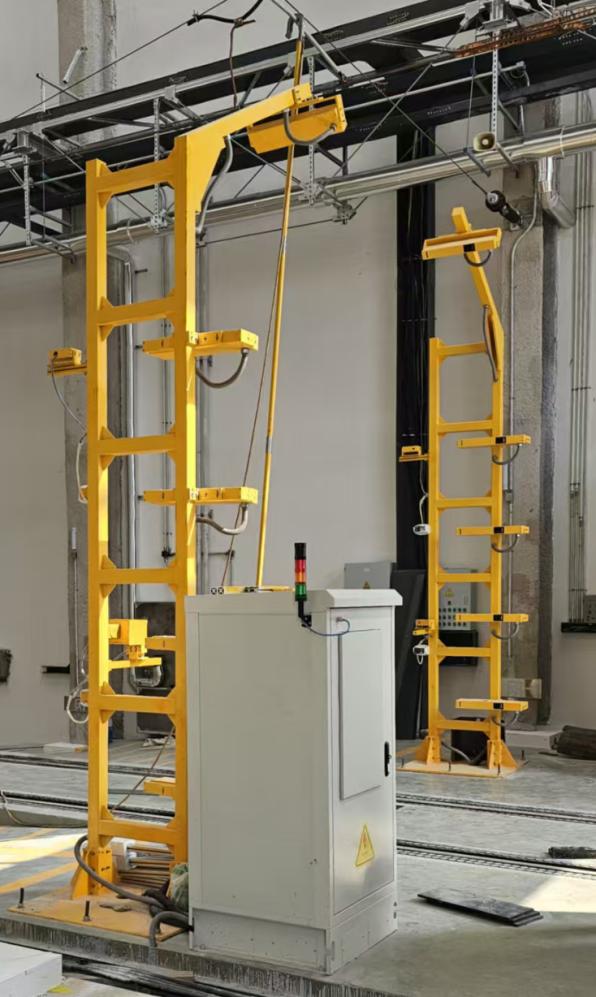
Designed for the inbound and outbound operations of rail transit depot maintenance scenarios, the system deploys gantry-type detection units and trackside cabinets at the entrances and exits of the static test depot. By leveraging vehicle entry/exit signal sensors, speed measurement modules, vehicle identification cameras, 3D laser profilometers, and area-array cameras, the system achieves full-process automation encompassing "vehicle reception — data acquisition — comparative analysis — alarm verification." Upon vehicle arrival, the system automatically triggers data acquisition, dynamically adjusts the acquisition frequency based on real-time vehicle speed, compares the vehicle's point cloud with a standard limit template, automatically identifies any exceedances, and determines the corresponding coordinates. The detection results are presented via a web interface, supporting historical query, report export, and manual verification. This solution replaces conventional mechanical limit detection with a contactless, high-precision, and fully automated online detection approach.
Overall Technical Parameters
Technical Specifications Overall Parameters
Detection Method Non-contact dynamic laser scanning + machine vision (3D laser profiler + 2D area-scan camera)
Applicable Train Speed 1–5 km/h
Vehicle Clearance Detection Accuracy ±2 mm
Out-of-gauge Point Positioning Accuracy ±1 m (track-direction coordinate, height coordinate)
Alarm Response Time Audible/visual alarm within ≤4 s after the out-of-gauge object passes the detection unit
Car Number Recognition Accuracy ≥99%
System Data Processing Time ≤3 min per single train pass
Historical Data Retention ≥30 days; supports query, printing and report export
Power Supply AC220V, approx. 5 kW
Network Communication Internal Ethernet TCP/IP, bandwidth ≥100 Mbps, latency <50 ms
Operating Mode 7×24 h continuous online operation
Working Principle
When the train passes through the gantry, the vehicle entry/exit signal sensors and the speed measurement module first detect the train's arrival and measure its real-time speed; the processing host then issues acquisition commands to the 3D laser profilometer, the face-array camera, and the vehicle number camera. Each module dynamically adjusts its scanning frequency based on the vehicle speed to synchronously scan the vehicle body, thereby generating real-time 3D point clouds of the vehicle roof and sides, as well as high-definition 2D images. The processing host automatically compares the point cloud data with the standard gauge template for the specific vehicle model to determine whether any dimensional limits have been exceeded, calculate the coordinates of any exceedances, and simultaneously identify the vehicle number information. The detection results, fault alerts, and corresponding real-world image evidence are then written to the database, enabling operators to view, verify, and trace this information via the web interface.
Why Choose Us
Non-contact high-precision detection
A line laser profilometer is employed to perform 3D scanning of the vehicle surface, achieving a body contour detection accuracy of ±2 mm, thereby avoiding wear and scratches caused by direct contact between traditional mechanical devices and the vehicle body.
Dynamic, real-time, and fully automated completion
When a vehicle travels at a constant speed of 1–5 km/h through the inspection zone, the system automatically completes data acquisition, comparison, and judgment; if an over-limit fault occurs, an audible and visual alarm can be triggered within 4 seconds—requiring no manual intervention and without affecting the inbound/outbound throughput rate.
Multi-vehicle adaptive capability
The system automatically identifies vehicle license plate numbers and retrieves the corresponding clearance templates, enabling flexible addition and modification of clearance standards for vehicles of various models; a single device can thus meet the inspection requirements for diverse vehicle types within a depot.
Data retention and fault visualization
Vehicle point clouds, exterior images, and license plate information are automatically uploaded to the database; areas exceeding regulatory limits can be mapped to 2D real-world images, facilitating remote verification, historical query, and statistical analysis, with a retention period of no less than 30 days.
About Us
Founded in 2018, DITT applies AI visual intelligence to rail transit. Built on our own visual perception algorithms, intelligent hardware and O&M systems, we deliver a full inspection portfolio spanning onboard and wayside applications, now serving 20+ rail transit systems across China.

Together with our subsidiaries — Zhonggang Maintenance, Zhongshu Laser and Yunshang Urban Rail — we are moving rail transit O&M toward predictive maintenance and full-lifecycle management.
0
Company Establishment
0+
Invention Patents
0+
Metro Clients Served
0%+
R&D Proportion of Revenue
Ready to find the right solution?
Our engineers will recommend the best-fit configuration for your specific application — at no cost.
Inquire Now
Related Products
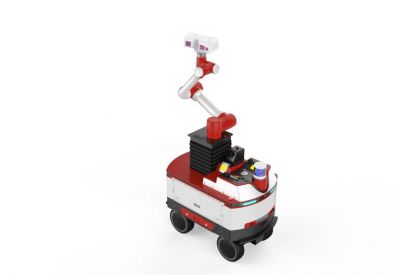
The vehicle inspection robot system primarily consists of a robot, charging stations, track transfer equipment, a wireless network, a backend processing center, and a management platform. By leveraging the robot, computer vision technology, diverse control techniques, and advanced algorithms, the system automatically captures images of the undercarriage and side of the vehicle, and can utilize these algorithms to detect and identify vehicle anomalies.
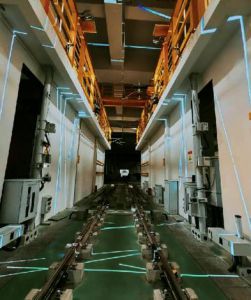
The 360 system integrates high-definition imaging and deep learning technologies to enable non-stop intelligent detection, accurately identifying the status of critical components in trains. This capability facilitates efficient fault diagnosis in metro operations and maintenance, thereby providing comprehensive safeguards for the operational safety of urban rail transit systems.
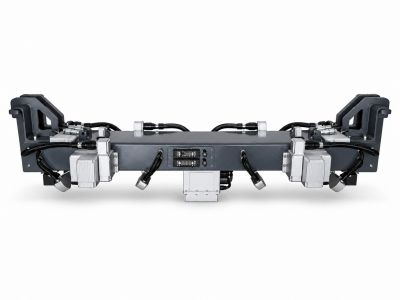
Based on a non-contact track inspection framework, this system employs the inertial reference measurement principle and integrates multiple precision sensors to leverage operational vehicles as carriers, enabling dynamic, real-time monitoring of track geometric parameters and track inspection defects.
Latest News
On September 24, Li Jun, Deputy Director of the Qiantang New Area Management Committee of Hangzhou, Zhejiang Province and President of the district’s Western Returned Scholars Association, led a delegation from the Association on a visit to DITT.
On August 30, 2025, Changzhou Metro Group held the "Changzhou Metro Line 1 EMU Intelligent Inspection System Expert Review Meeting" at the Baizhang Depot.
Frequently Asked Questions
Will this device come into contact with the train car body?
No. The device employs non-contact laser scanning and visual imaging technology for detection, thereby eliminating the risk of wear and scratching associated with the direct contact between conventional mechanical devices and the vehicle body.
Can the system be compatible with different vehicle models?
Yes. The system supports automatic vehicle identification and retrieves the corresponding boundary templates; when encountering a new vehicle model, you can add a new standard boundary template coordinate set via "System Management – Template Settings," thereby achieving compatibility and adaptation.
What are the detection accuracy and response speed?
The body clearance detection accuracy can reach ±2 mm, and out-of-specification faults can trigger audible and visual alarms within 4 seconds, meeting the rapid inspection throughput requirements of the depot.
Whether the test data can be stored and traced.
Yes. The system automatically writes the vehicle body point cloud, exterior images, vehicle license plate information, and over-limit records into the database; historical data is retained for no less than 30 days, and queries as well as report exports can be performed based on criteria such as vehicle license plate number, task number, or timestamp.
What are the system requirements for the operating environment?
The device is designed for continuous online operation, powered by AC 220V at approximately 5 kW, with internal communication based on Gigabit Ethernet (latency <50 ms), and it is capable of withstanding the typical on-site temperature and humidity conditions found in rail transit depot environments.
Is there a speed limit for vehicles?
The system is configured to allow the vehicle to traverse the inspection zone at a constant speed of 1–5 km/h; the acquisition frequency is then automatically adjusted based on the real-time vehicle speed to ensure that the point cloud data remains undistorted and free from compression or stretching artifacts.
How to respond to an over-limit alarm
Upon activation of the audible and visual alarm on the pole-mounted cabinet, the operator may access the "Fault Alarm" page via the web interface to view the fault location, over-limit values, and fault severity level; then, in conjunction with live evidence images, perform a manual verification, update the verification status to "Fault Confirmed" or "Pending Verification," and proceed with the corrective actions in accordance with the on-site operating procedures.
Product Inquiry
Whether you'd like a quotation or simply want to learn more about us, we're happy to hear from you.
201
Phone
WhatsApp
Email
LinkedIn
Facebook