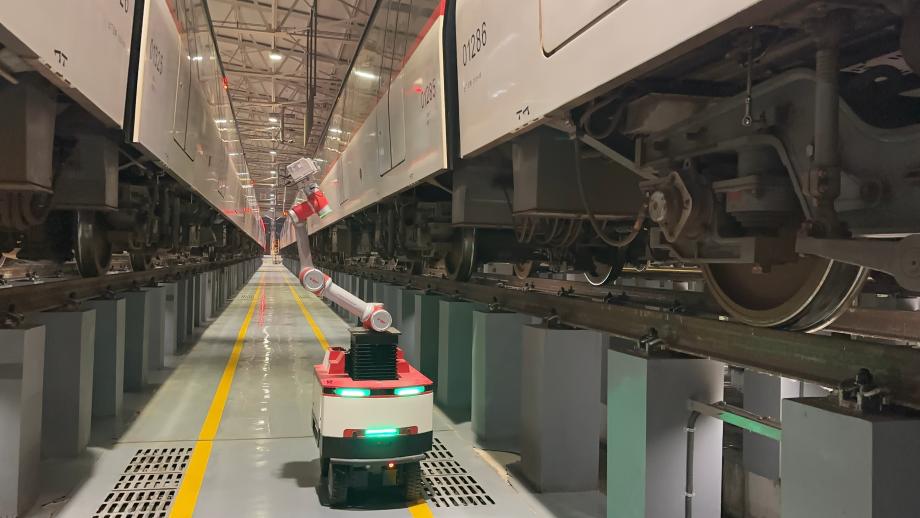
Train Inspection Robot
Robotics and vision for automated train inspection.
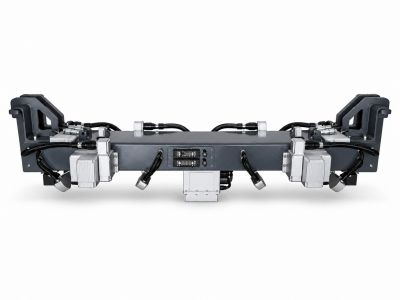
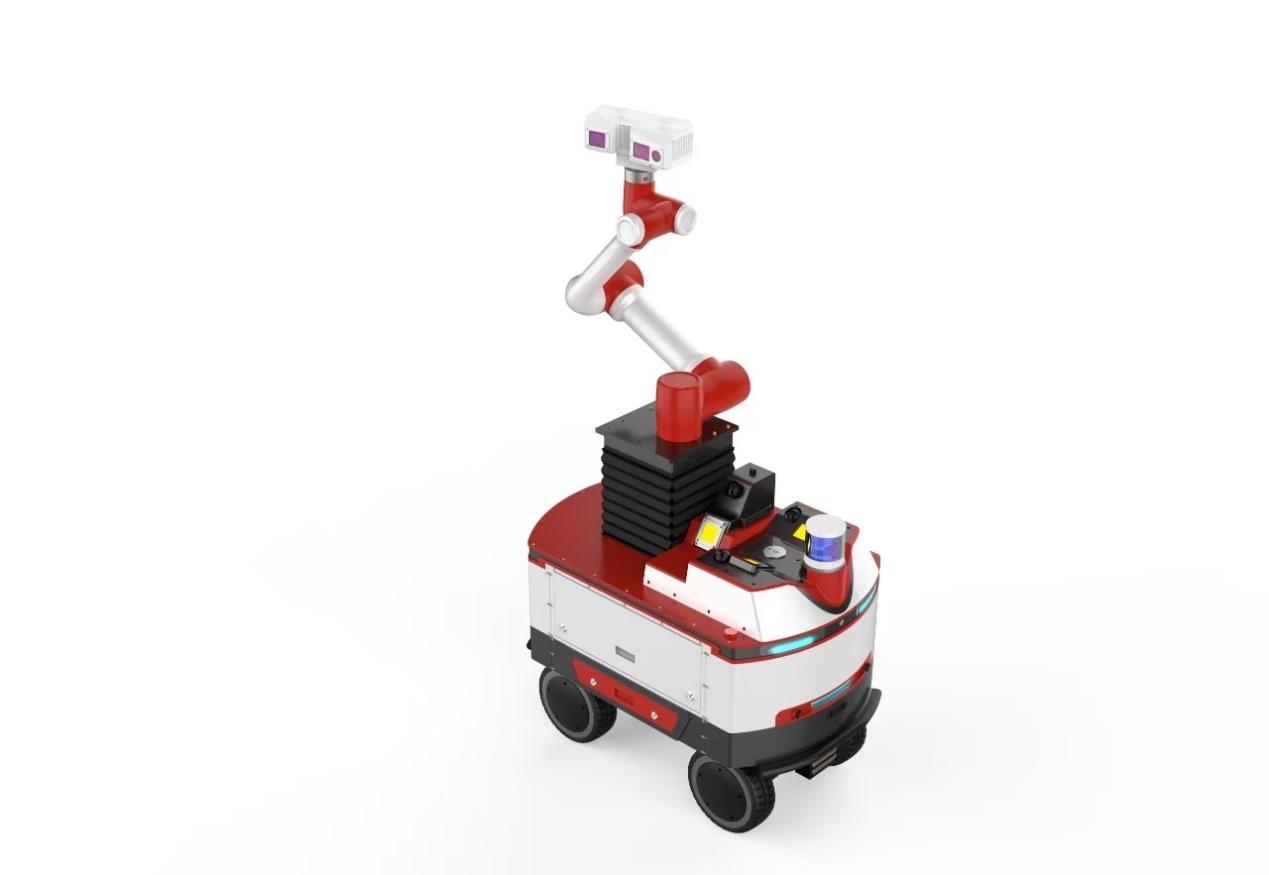
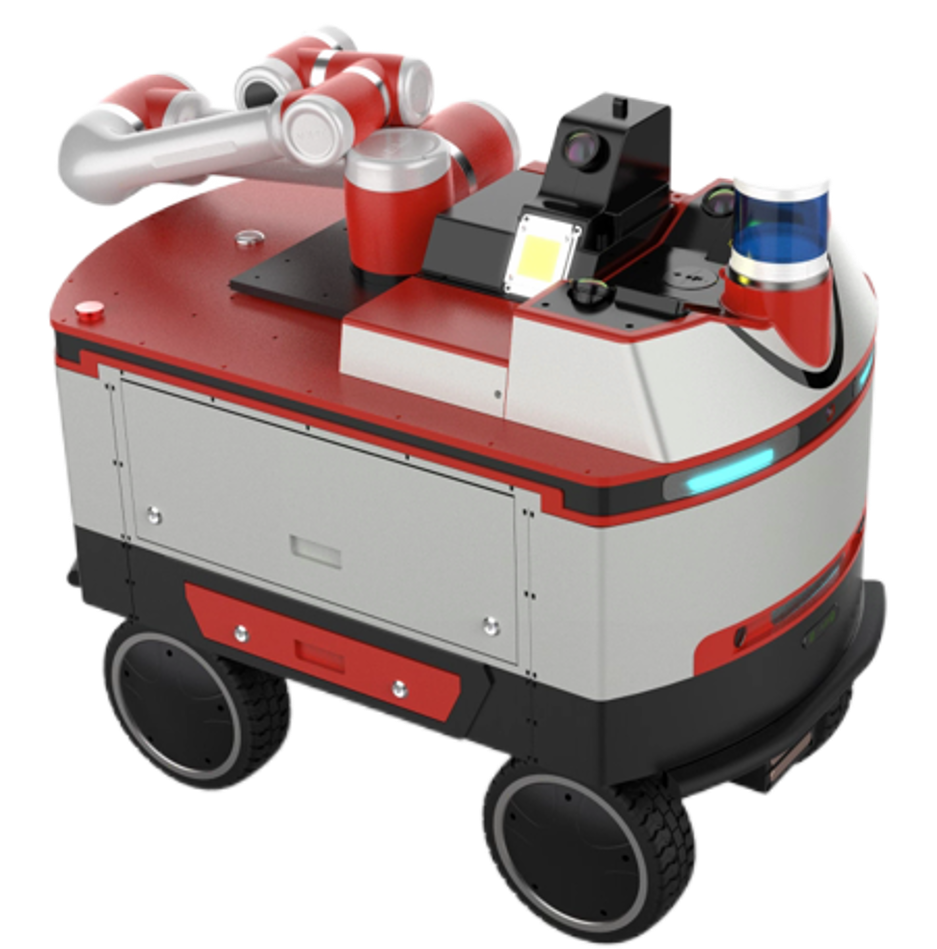
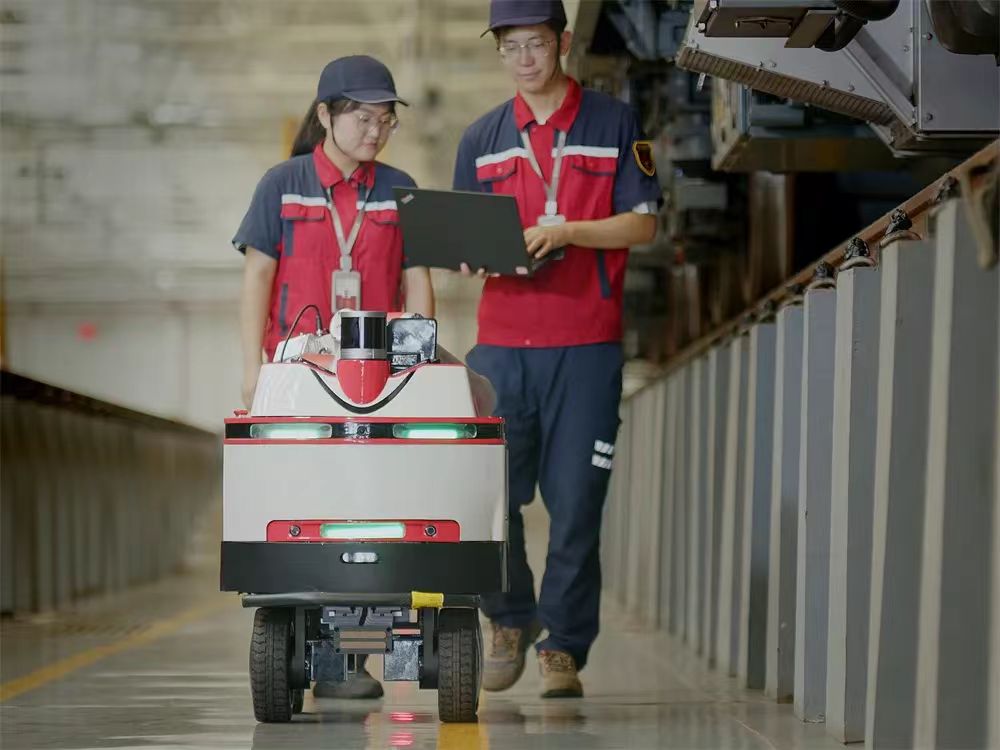
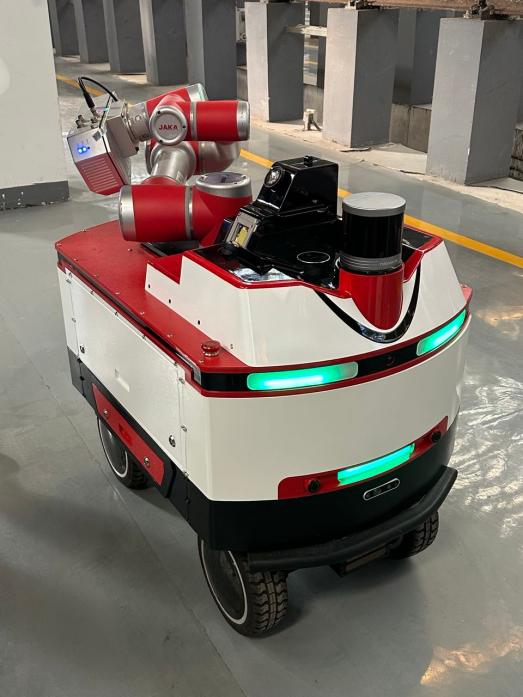
The vehicle inspection robot system primarily consists of a robot, charging stations, track transfer equipment, a wireless network, a backend processing center, and a management platform. By leveraging the robot, computer vision technology, diverse control techniques, and advanced algorithms, the system automatically captures images of the undercarriage and side of the vehicle, and can utilize these algorithms to detect and identify vehicle anomalies.
Solution
The rail inspection robot system primarily consists of rail inspection robots, charging stations, track transfer devices, a wireless network, a backend processing center, and a management platform. It can deliver customized system solutions tailored to the on-site environment and inspection requirements, enabling the automated execution of robot inspection tasks. Inspection data and results are uploaded in real time to the platform, where users can perform item-level verification and feed the verification results back to the algorithmic model, thereby supporting the algorithm's learning and iterative refinement processes.
Product Demo Video
Watch our Product in real operation to directly see its efficiency and performance.
Overall Technical Parameters
Technical Specifications TITR041
Stowed Dimensions ≤980 × 600 × 900 mm (L × W × H)
Maximum Height 2300 mm
Maximum Travel Speed 1.5 m/s
Working Speed 0.4 m/s (during acquisition); 1 m/s (during non-acquisition)
Climbing Ability 25°
Wading Capability 10 cm
Obstacle-Crossing Capability 10 cm
Steering Mode and Turning Diameter Spin turn (in-place rotation); turning diameter 1 m
Charging Time 1.5 h
Endurance Time 6 h
Track Transfer Method Lift platform transfer / side-slope transfer / front & rear slope transfer
Working Principle
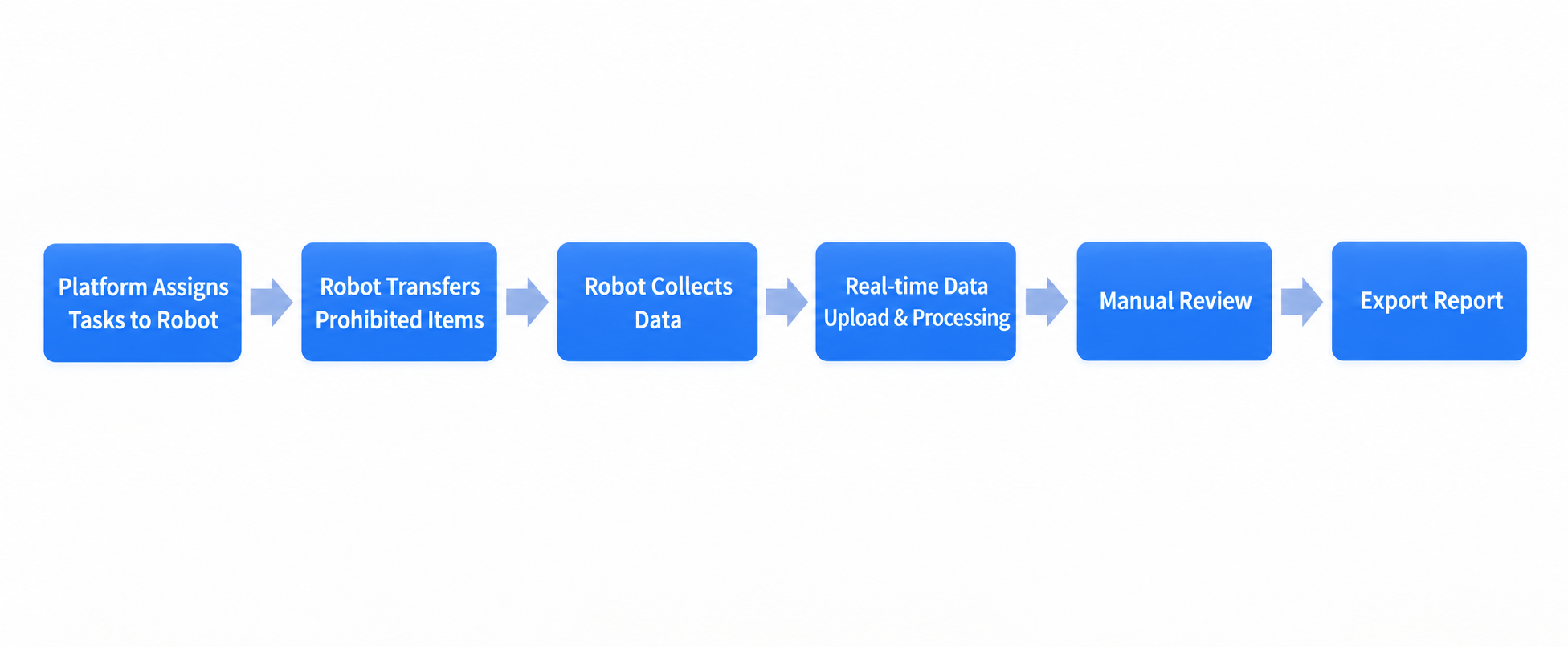
Working Process of the Inspection Robot: ① The user issues an inspection task via the robot management platform. Upon receiving the task, the robot travels to the corresponding track; ② The robot is transferred to the vehicle‑side of the target track by the track transfer device, and completes position correction and train number recognition; ③ It captures panoramic images of the vehicle undercarriage and vehicle sides. Equipped with an end‑mounted 3D acquisition module on its mechanical arm, the robot docks to collect key points on the vertical surfaces of the vehicle undercarriage; ④ During acquisition, images are transmitted to the data processing center in real time through a wireless network for real‑time data processing. After data collection is finished, the robot is transferred out of the track and returns to the charging pile for recharging; ⑤ Inspection results are reported to the platform for manual review; ⑥ Reports are generated based on the manually‑reviewed results.
Why Choose Us
modular design
The robot employs a modular design, enabling real-time feedback on the status of its key components, which facilitates maintenance and management.
Equipment autonomous automation
Robots can autonomously perform path planning based on assigned tasks, and multiple robots can flexibly collaborate in operations.
Stable and reliable operation
The robots have already undergone application validation across multiple metro line projects in several cities, including Changzhou, Hangzhou, and Suzhou, demonstrating safe and stable operation.
The test results are accurate and reliable.
The inspection robot ensures comprehensive inspection coverage without omissions or missed detections, maintains a low false-positive rate, and allows manually verified results to be fed back into the algorithmic model to support iterative model learning.
About Us
Founded in 2018, DITT applies AI visual intelligence to rail transit. Built on our own visual perception algorithms, intelligent hardware and O&M systems, we deliver a full inspection portfolio spanning onboard and wayside applications, now serving 20+ rail transit systems across China.

Together with our subsidiaries — Zhonggang Maintenance, Zhongshu Laser and Yunshang Urban Rail — we are moving rail transit O&M toward predictive maintenance and full-lifecycle management.
0
Company Establishment
0+
Invention Patents
0+
Metro Clients Served
0%+
R&D Proportion of Revenue
Ready to find the right solution?
Our engineers will recommend the best-fit configuration for your specific application — at no cost.
Inquire Now
Related Products
The 360 system integrates high-definition imaging and deep learning technologies to enable non-stop intelligent detection, accurately identifying the status of critical components in trains. This capability facilitates efficient fault diagnosis in metro operations and maintenance, thereby providing comprehensive safeguards for the operational safety of urban rail transit systems.
A non-contact dynamic limit detection system, based on a 3D laser profilometer and machine vision, automatically performs external profile acquisition, limit exceedance assessment, and audio-visual alarms when vehicles pass through; this system provides real-time limit safety assurance for the entry and exit operations of rail transit vehicles during maintenance.
Based on a non-contact track inspection framework, this system employs the inertial reference measurement principle and integrates multiple precision sensors to leverage operational vehicles as carriers, enabling dynamic, real-time monitoring of track geometric parameters and track inspection defects.
Latest News
On September 24, Li Jun, Deputy Director of the Qiantang New Area Management Committee of Hangzhou, Zhejiang Province and President of the district’s Western Returned Scholars Association, led a delegation from the Association on a visit to DITT.
On September 18, the three-day "2025 China International Urban Rail Transit Exhibition" (MetroTrans 2025) officially opened at the CRCC Qingdao World Expo City.
Frequently Asked Questions
Will debris on the trackbed and track misalignment affect the robot's inspection operation?
The robot is equipped with a suite of safety protection features, including autonomous obstacle avoidance and collision/edge detection; upon encountering an obstacle, it can pause its operation and trigger an alarm, resume its task once the obstacle has been cleared, and automatically correct its trajectory during movement, thereby ensuring the safety of inspection operations.
Could insufficient illumination within the storage facility at night affect the test results?
Equipped with an integrated fill light source, ensuring stable imaging regardless of changes in garage lighting conditions.
How long does a complete inspection of an entire train take?
Under normal operating conditions, the side‑inspection time for a 6‑car consist shall not exceed 50 minutes.
Does on-site deployment require extensive civil engineering modifications?
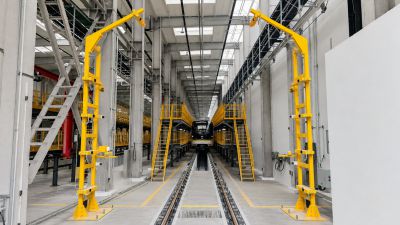
The robot exhibits excellent obstacle-crossing and climbing capabilities, supports multiple track transfer modes, and can be configured with minimal retrofitting requirements based on on-site conditions; it has been successfully deployed in both new and existing yard projects, and its civil engineering retrofitting solutions are well-established.
Can the electric passenger train be adapted to operate on multiple routes and accommodate a variety of train models?
It supports multi-vehicle template configuration and adopts a "one vehicle, one template" management model, enabling rapid addition of inspection point databases for different vehicle models to meet the needs of mixed-vehicle inspections.
Does the system support conducting re-inspections only on specific items, rather than requiring re-inspections of entire rows?
The system supports the configuration of specialized maintenance tasks, enabling the assignment of dedicated inspection tasks for single-sided operations or specific categories of critical items; these tasks can then be manually issued.
Product Inquiry
Whether you'd like a quotation or simply want to learn more about us, we're happy to hear from you.
325
Phone
WhatsApp
Email
LinkedIn
Facebook